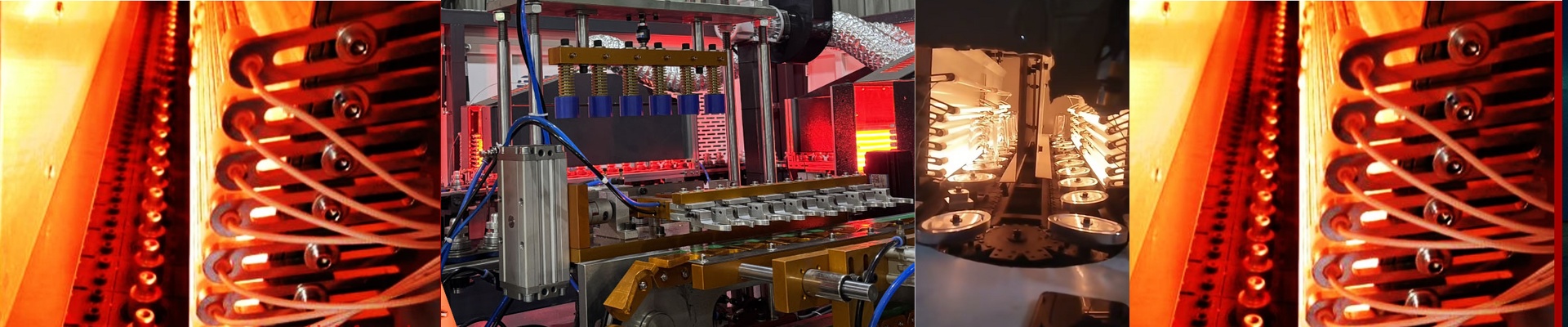
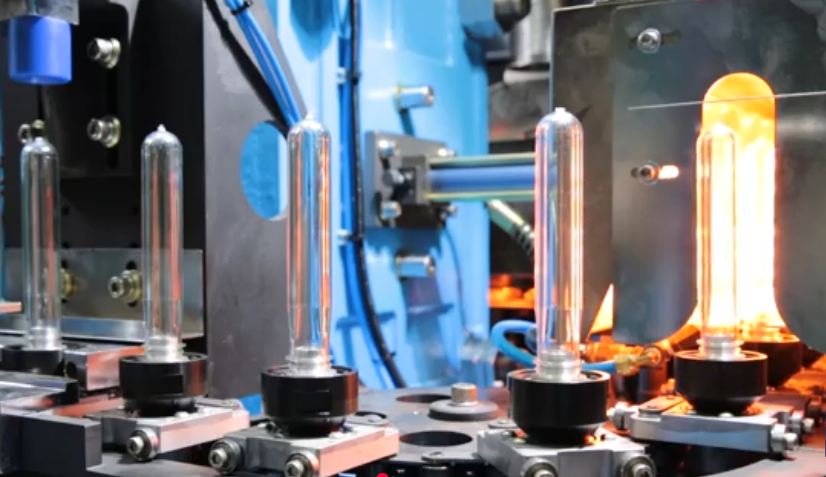
On the blow molding line, the heating tunnel is where the shift gets won—or lost. Preforms roll through on the carousel, and those infrared lamps have to nail a tight temperature window, fast, before the stretch blow station. When the heating falls short, you feel it everywhere: cycle times creep up to compensate, bottle wall thickness starts to wander, and scrap piles up from crystallization or weak biaxial orientation. Then the maintenance tickets follow. Every lamp change is downtime. Every spare part is a line item. We built a heating lamp package that swaps out standard halogen and quartz infrared emitters without reworking the heating tunnel geometry or rewriting the control logic. The aim is straightforward: deliver repeatable radiant heat, stable output, quicker warm-up, and a longer service life—so you get more shots per hour with less energy and fewer replacements.
What matters, under the hood
Heating lamps in blow molding aren’t just “heat sources.” They’re matched to the PET preform, the cycle time, and how the machine lays out its heating zones. In stretch blow molding, the preform needs rapid, uniform heating to the right surface temperature—typically 90–110°C for most PET applications—without scorching or pushing the material into over-crystallization. Our lamp family covers different infrared spectra to fit different process windows:
- Short-wave infrared for fast response and high intensity—ideal for fast-moving carousels and short dwell times.
- Medium-wave infrared for deeper penetration and smoother temperature profiles, a good fit when preform wall thickness varies.
- Carbon-element emitters for even radiance and long life in heating tunnels that run continuously. The specs are chosen to match what the machine already has to live with:
- Voltage and power density: Common setups run 100–240 V AC, with power sized per zone so you can keep the existing loading and avoid rewiring the panel.
- Emitter geometry: Straight tubes and compact coiled elements that drop into standard lamp holders and keep reflector spacing where it should be.
- Mounting and connections: R7s bases, mogul screw bases, and custom brackets to match sockets and alignment in Sidel, Krones, SIPA, Husky, SACMI, and Nissei ASB heating tunnels.
- Control compatibility: Output that behaves predictably with PID control, so you keep the same setpoints and tuning approach.
- Thermal behavior: Fast warm-up to cut startup scrap, and stable output over thousands of hours to keep heating drift out of your quality window. It isn’t about “more heat.” It’s about predictable heat—delivered at the right wavelength, the right intensity, and the right repeatability.
Why this matters on the floor
In a blow molding cell, the heating lamp is directly tied to throughput and scrap. If lamp output drops off, the control system chases temperature, and the process compensates by slowing the line or widening the tolerance band. You end up losing cycles and making off-spec bottles. With the right heating lamps, you get three outcomes you can measure. **Consistent preform heating.**Tighter temperature uniformity across the heating zone reduces variability in stretch ratio and wall distribution. In practice, that means fewer rejects from weak orientation, haze, or crystalline spots. **Faster recovery, shorter warm-up.**Infrared emitters with rapid response bring the heating tunnel back to setpoint quickly after a jam clears, a changeover, or a restart. Less warm-up time translates into more production minutes per shift. **Real operating savings.**Plants often cut heating-tunnel energy use by 15–30% when switching to optimized infrared emitters, because the emitter draw is closer to the actual heat load and there’s less waste heat bleeding into the cabinet and nearby components. And you change lamps less often. Many customers stretch emitter service intervals from a few thousand hours to 6,000–8,000 hours under normal conditions, depending on duty cycle and operating temperature. Fewer replacements mean less downtime and fewer spares consumed. Put it together and the impact shows up in the numbers. Across multiple lines, typical results include:
- Energy reduction: 15–30% lower heating-zone energy use, measured at the cabinet.
- Scrap reduction: 20–50% fewer heating-related rejects (thickness variability, haze, crystallization) after process re-optimization.
- Maintenance reduction: 30–50% fewer lamp replacements per year, which directly cuts labor and spare-part costs. These figures vary with line speed, preform weight, and how worn the original lamps were—but the pattern holds: stable heating lowers cost per bottle.
The practical details you need
Replacing heating lamps is straightforward, but there are constraints you should plan around.
- **Compatibility is part engineering, part inventory.**Even within a single brand—Sidel, Krones, SIPA, Husky, SACMI, Nissei ASB—heating tunnels can differ by model year, zone layout, and socket type. Confirm base type, length, wattage, and voltage before ordering. If your line uses custom brackets or reflectors, match the emitter dimensions so focal distance stays correct.
- **Controls tuning may be required.**Infrared output changes with spectrum and emitter design. After installation, run a controlled warm-up and verify setpoint stability. Retune PID if needed, and document the new heating-zone profile.
- **Thermal management matters.**The heating tunnel is hot, and airflow is often tight. Make sure the lamp and socket stay within rated temperature limits. If you’re seeing socket failures, address heat soak and wiring strain at the same time you change emitters.
- **One trade-off is real: higher peak intensity can increase localized heating.**Short-wave infrared gives fast response, but you need to ensure preform rotation and dwell time prevent hot spots. If you run thick-walled preforms or specialty PET blends, medium-wave or carbon-element emitters can produce a smoother profile. If you’re chasing more uptime, lower energy draw, and fewer lamp changes, treat the heating lamp as a controllable variable. Match the emitter to your preform, your cycle, and your machine—then watch what changes in energy, scrap, and maintenance hours. If you want a lamp spec that fits your blow molder—Sidel, Krones, SIPA, Husky, SACMI, or Nissei ASB—send the model, the heating zone layout, and your current lamp details. We’ll give you the exact replacement configuration and the performance data you need to justify the changeover.